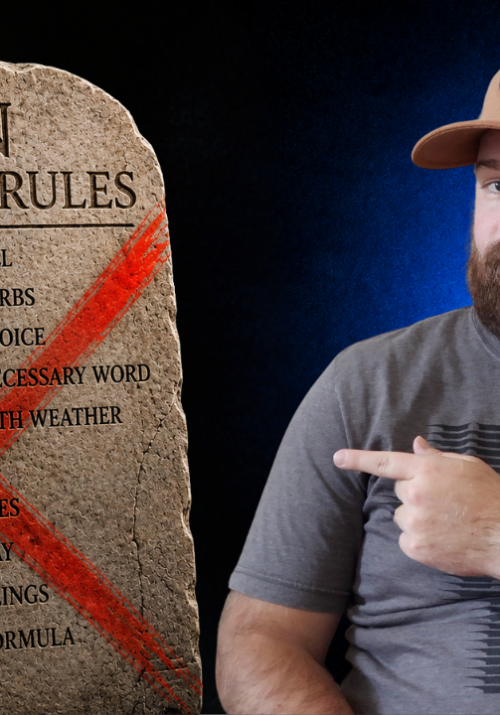
There is a trap of discovery writing for inexperienced writers. The trap is this: discovery writing often turns into scattered story beats that aren’t connected in a satisfying way for the reader. To fix your plot in such cases, use the “but, Therefore” rule to ensure a through line for each story beat.
Continue reading or watch the video below!
The Rule: “But, Therefore,” Not “And Then”
Good writing becomes storytelling with one simple rule that comes to us from the creators of South Park. If your beats are connected with and then, then you don’t have a story—you have a series of unconnected events that would resemble a scatter plot if you could figure out a way to graph it. However, if you can connect the beats in your story with but or therefore, then you have a story driven by cause and effect.
When reading or thinking about an existing story, it can sometimes seem like there are and then events if you’re looking at the story with a broad lens. In such cases, you may have to drill into the individual events and see if you can create a chain between them.Let’s look at an example. Maybe a volcano erupts, and then your character survives. But what if you dive deeper? If you were writing this story, a good place to start would be to ask yourself: how would someone on the volcano survive if it erupted? What would they have to do?Let’s look at Bill the volcanologist. The volcano erupted, killing the pilot, therefore Bill has to fly the helicopter out. But Bill doesn’t know how to fly a helicopter, therefore he crashes it. He survives, but his legs are broken and burned. Therefore, when he’s saved, the doctors have to amputate his legs.Again, the macro view of the events would be that the volcano erupted and Bill survived, but if you drill into the events, there is a chain of causality. If you graphed it, all the lines would connect.
Applying the Rule to Character Arcs
Not only is this idea useful for solving issues with plot, but it can also help you solve problems you may have with individual characters. Every character arc needs therefores and buts. Plot examines the different events within a story, but character arcs examine how these events change individual characters. You should be able to connect things like character actions, feelings, and behaviors to the events that are happening.
Let’s say your character experienced the death of a close friend. How would that affect the character? Would your character act the same? Probably not. As far as behavior goes in that situation, it’s unclear—but there should be a therefore statement in there that joins the event and the behavior. Paul’s mother died, therefore he has lost his appetite.
It doesn’t matter if these events are happening to characters, or if they are active participants in the events—I think most good stories have a combination of both scenarios—the important part is that these events have a logical impact on the characters. There needs to be a chain of causality that shows the changes in the characters.
Using “Therefore” for Growth
In cases of character arcs, therefore should be used for character growth. Let’s say you have a character named Janice, and Janice doesn’t want help from anybody. You could start with a scene where Janice refuses help, and therefore she fails because she tries to do everything herself. She learns from her mistake and starts accepting help from others. In this case, the therefore events form a chain that shows growth in Janice.
Using “But” for Conflict
The conjoining of events with but should be used to introduce conflict for characters. Let’s say Janice finally gets over her trust issues, but is betrayed by a friend. This would cause interesting internal conflict for Janice. She is betrayed, thereforeshe slides into further, more extreme distrust. This could be a descent into hatred, or the beginnings of a new struggle to trust again.
Test the Lessons Your Characters Learn
Lessons learned by characters should be tested, and tested soon after the learning. Let’s take Janice again. If she learns to trust, then you as a writer should put her into a situation where she has to use that lesson. If your characters learn something and it’s never tested, there isn’t a clear chain of connectivity between events. At that point you’d just think: why did Janice learn to trust, if she never has to trust anybody again?
Let’s take bravery. If your character has to learn bravery, then it would be appropriate for them to therefore volunteer for the dangerous mission. Or maybe your character is afraid, but they have no choice but to go on the dangerous mission. You can even combine the two chains: your character learns bravery, but their bravery turns to hubris—therefore they volunteer for a dangerous mission, but then they fail.
Consequences Drive the Plot
No matter what happens, it’s important to know that everything your character does—every decision they make—should have consequences. These consequences will drive the plot forward. Choices produce consequences, consequences create new choices. Another important tidbit is that consequences often matter more than the events that cause them.
How to Know If a Scene Is Necessary
To know if a scene is necessary, you should think about where it fits into your chain of events. You need to look at what each scene accomplishes. If you have a scene that doesn’t change anything, you might want to throw that scene out. Changes could include new information, a new goal, a new relationship, a new danger, a new failure, a new success, and many more.
Goals and Desires Are the Glue
Cause and effect often breaks down when characters lose sight of what they want. This makes me think that character goals and desires can kind of be viewed as the glue of cause and effect. Every few scenes should remind the reader what the characters want, and highlight how getting what they want is becoming harder. This is a natural way to push your plot and characters forward.
Is There Room for Coincidence?
Going back to therefore, but, and and then causality, I would say that coincidences fit more into the and then bucket. I think it would be wise to cut coincidences from your story after the beginning. Coincidences can start a story, but they cannot carry one.
Reverse Outlining: A Second-Draft Check
When you’re done with your story and about to start the second draft, it might be wise to reverse outline what you’ve written. Go through your story one chapter or scene at a time and write a sentence that describes the scene. If you can trace each scene back to something previous in your story, then you’re doing pretty good—you have a chain of causality that establishes a nice graph rather than a scatter plot.